The Neutral Authority Method™ - THE E-BOOK
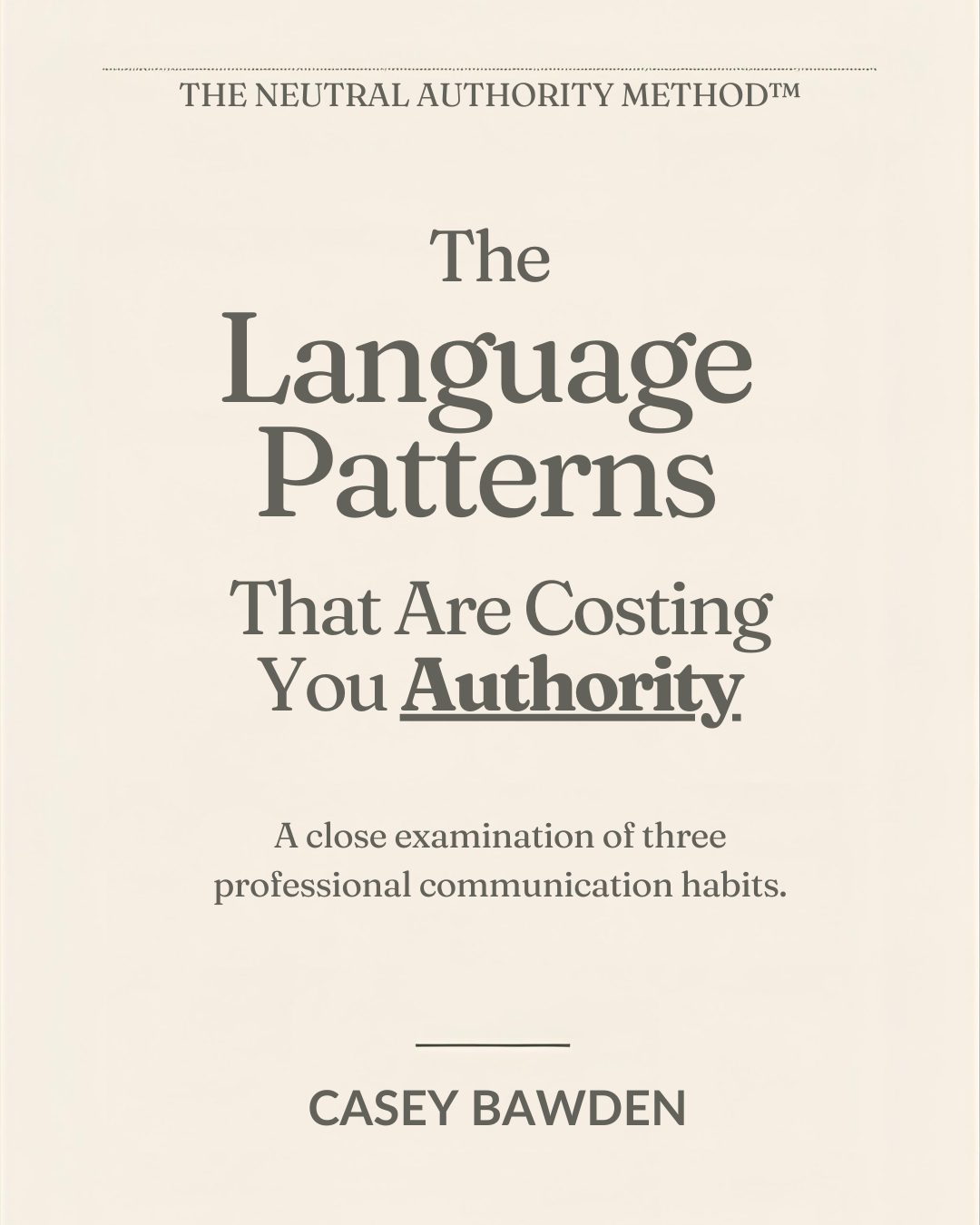
Most professionals are undermining their own authority every day.
They have no idea it's happening.
Not through incompetence. Not through poor judgement. Through language — specific, habitual patterns that feel like courtesy but are quietly costing authority, energy, and outcomes with every email sent and every meeting opened.
Buy on Amazon Australia →
Buy on Amazon US →
Buy on Stan Store (PDF) →
THE PATTERNS
These patterns appear in every professional environment. They are not personality flaws. They are conditioned communication habits — responses to hierarchy, conflict, and the need to preserve professional relationships. The problem is not that they exist. The problem is that most people have never been asked to look at them.
Pattern One Reflex Apology "Sorry to bother you — I just wanted to check…" Fault assigned before any has occurred. The apology is not about fault. It is about anticipation — and what it costs.
Pattern Two Negative Framing "Unfortunately, we can't accommodate that request." Language that instructs the recipient to feel negatively before a single fact is delivered. The fact is neutral. The framing is not.
Pattern Three Hedging and Cushioning "I think maybe we could possibly look at this differently…" Qualifiers that dilute authority, signal uncertainty, and invite negotiation — when none was warranted.
Three patterns. Invisible until they aren't.
WHAT THE BOOK IS
An examination. Not a manual.
The Neutral Authority Method takes three professionals — David, Priya, and James — and follows them into the ordinary moments where these patterns appear: an email thread that subtly undermines a position, a meeting where framing instructs emotional response before facts are delivered, a forwarded message where every hedge dilutes the authority behind it.
Through their experiences, the patterns become visible. And once visible, they become very difficult to stop seeing.
There are no tips, no scripts, and no phrases to memorise. It is a close, careful look at the language habits that shape professional life in ways most people have never been asked to see.
This book is not: — A confidence programme — Assertiveness training — Scripts or templates to copy — Personality-based coaching — Motivation or mindset content — A quick-fix communication guide
CHAPTERS
What's inside
Chapter 1 Reflex Apology
The Email David Has Been Sending for Eight Years David is good at his job. His emails are thorough, considered, professional. They are also quietly apologising for his existence in every other line — and he has never had cause to notice it. Until now.
Chapter 2 Negative Framing
The Meeting Priya Thought She'd Handled Well Priya is a precise communicator. She prepares. She structures. She also frames neutral information as negative before she's delivered a single fact — and the outcomes she's been attributing to the audience's reaction are partly her own construction.
Chapter 3 Hedging and Cushioning
The Memo James Almost Got Right James's thinking is clear. His recommendations are sound. His language spends three qualifiers undoing every point he makes — and the authority he's wondering why he isn't getting is leaving through the hedges.
Chapter 4 Where to Go From Here
The patterns are now visible. That recognition doesn't reverse — but it also doesn't come with instructions. This chapter addresses what happens next: what the visibility means, what it doesn't mean, and where to go if you want the structural tools to act on what you've seen.
"Before anything can change, the pattern has to become visible. And once it does, it becomes very difficult to stop seeing it."
WHO IT'S FOR
This book is for professionals at any level who suspect their language is working against them — but haven't had a framework for examining it.
Early-career professionals who are developing communication patterns right now — before the habits solidify.
Mid-career professionals who have noticed something is off in how their communication lands — but haven't been able to name it.
Leaders and managers who want to understand how defensive language patterns affect authority and escalation cycles.
Anyone who drafts and redrafts messages, replays conversations, and carries professional interactions longer than is useful.
AUTHOR

Casey Bawden
Creator, The Neutral Authority Method™
Casey Bawden developed The Neutral Authority Method™ through sustained observation across nearly two decades in escalation-heavy professional environments — corporate, compliance, client-facing, and financial enforcement.
The core insight was consistent across every context: professional instability is not a personality problem. It is a structural language problem. Specific, predictable patterns create specific, predictable costs — and most professionals are running those patterns without ever having been asked to examine them.
The Neutral Authority Method™ formalises those observations into a framework. This book is where the examination begins.
FAQ
Before you decide
Is this a self-help book?
Not in the conventional sense. There is no motivational content, no mindset reframing, and no encouragement. It is a close examination of three language patterns and what they cost. If that leads somewhere for you, it will be because the recognition was real.
Will I get techniques and scripts?
No. This book is diagnosis, not prescription. It identifies the patterns and makes them visible. Structured application tools — scripts, frameworks, and a 30-day installation system — are available in the full Neutral Authority Method™ programme.
How long is it?
Approximately 90 minutes cover to cover. It is designed to be read in a single sitting — the recognition it produces is cumulative.
I want the full system. Where do I go?
The complete programme — including the 14-Day Recalibration Toolkit, Core Manual, and Script Library — is available at neutralauthoritymethod.com.